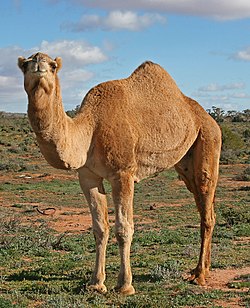
Semitic *gam(a)l-
'camel' is a widespread word which designates the dromedary of SW Asia and North Africa, first domesticated in Arabia before 2,000 BCE1, and was borrowed into Greek kámēlos and in turn into Latin camēlus.

This appears to be a Wanderwort which originally designated some wild ungulate of the Eurasian steppes and which is also found in Baltic *kumel-iā̃, Slavic *kobɨ̄lā 'mare' and in Altaic (with metathesis) *kúlme 'a k. of ungulate': Turkic *Kulum 'foal', Mongolian *kulan 'Mongolian wild ass (Equus hemionus hemionus)'2, Tungusic *ku(l)ma- 'maral (Siberian stag)/wapiti (Cervus canadensis)' and Japonic *kuáma 'foal, colt' aral' (EDAL 911).

__________________________________
1 Another species of camel,
the Bactrian camel,
native to the steppes of Central Asia, was first domesticated before 2,500 BCE.
2 Borrowed by Turkic, where it designates the Turkmenian kulan (Equus hemionus kulan).
3 Tocharian B kercapo 'ass, donkey' is likely an early Indo-Arian loanword. See D.A. Adams (1999): A Dictionary of Tocharian B, p. 195-196.
4 Although some authors have proposed a link to thieldones 'a breed of Asturian ambling horses' (Pliny) < IE *del- 'to shake' (cfr. English tilt), in my opinion this is semantically unsatisfactory.

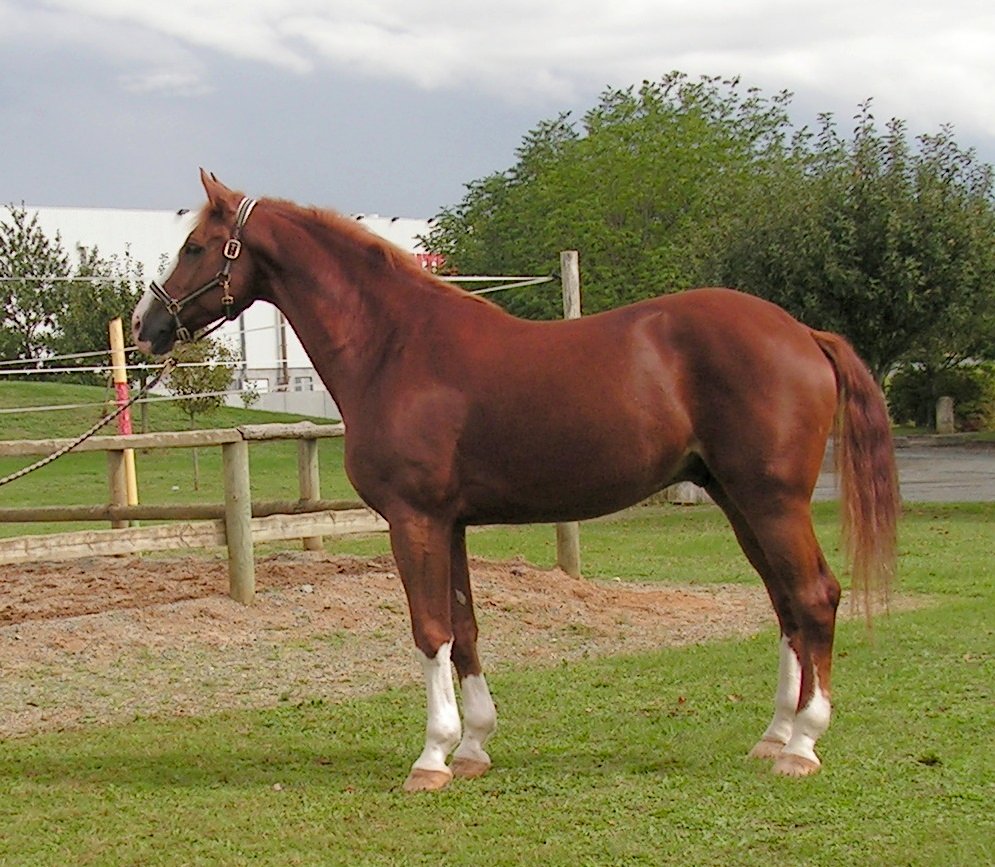
Late Latin caballus "horse" belongs here too; it is the source of horse's names in modern Romance languages. Moreover, etymologically dark Slavic *konjь ("horse", known from all modern Slavic lngs) must also be related. The term is believed to be simplified from older *komnjь, cf. Polish komonica = bird's-foot trefoil, Lotus (a plant that - as if - horses like much to eat).
ReplyDeleteThe name was a Wanderwort indeed, hence the irregural phonetic correspondences. Besides, the horse played a very important role in the lives of people long time ago, hence its name can have been a subject of irregular simplifications due to frequence (that is why we have -o- -less forms together with those with -o- in Slavic languages, in derived words).
Actually, the Latin word is a loanword from Gaulish, like other technical terms referring to horses and wheeled vehicles. Originally, it referred to draft horses, not horses in general as in Romance. While it's indeed possible for the Gaulish word to be related to the above Wanderwort, the intermediate languages (to account for the sound changes) can't be identified.
DeleteHowever, I can't say the same of the Slavic word you quoted. In fact, there're dozens of 'horse' Wanderwörter which aren't necessarily related.