
Eteocretan is a non-Greek language attested in a few alphabetic insciptions of ancient Crete, some of which are bilingual1. This is the case of Dreros 1, where we find the forms isalabre, isaluria, interpreted by Van Effenterre as variants of a compound word translated as 'goat cheese' upon an apparent resemblance of its first member with Greek íksalos '(castrated) male goat', of Pre-Greek origin2, as well as a presumed match to the forms turon, turo- (presumably 'cheese') in the Greek text3.
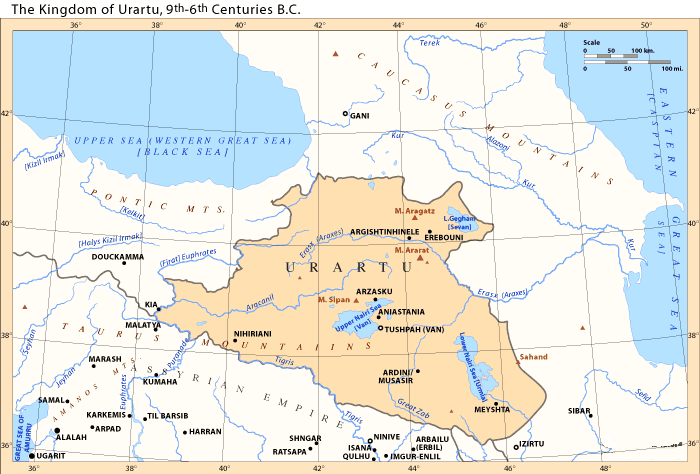
Interestingly enough, in the ancient Kingdom of Urartu (9th-6th centuries BCE) there was a fortress named Ispilibria, Ispilabria, Ispallure6 in Assyrian documents and whose resemblance to the Eteocretan forms is amazing: *Ispili-bría, *Ispila-bría, *Ispall-ure, also with an alternance between stressed -bría and unstressed -ure. It's then possible for isalabre, isaluria to be derived from Urartian if we assume a shift -sp- > *-sf- > -s- happened in Eteocretan7, so the original forms would be *Ispala-bre, *Ispal-uría.
The first member is possibly reflected in the ancient toponym Ispal/Spal (modern Sevilla), whose possible Phoenician origin hasn't been established.
__________________________
1 It's quite possible, alhough not certain, that Eteocretan is a descendant of Minoan, the Pre-Greek language of Crete attested in Hieroglyphic Cretan and Linear A.
2 There's also a femenine iksalê 'goatskin', with variants isálê, itthélê, ittélê, issélê, isséla, isthlê, itthéla, etc. See R.S.P. Beekes (2010): Etymological Dictionary of Greek, p. 593.
2 There's also a femenine iksalê 'goatskin', with variants isálê, itthélê, ittélê, issélê, isséla, isthlê, itthéla, etc. See R.S.P. Beekes (2010): Etymological Dictionary of Greek, p. 593.
3 See Ray Brown's web page.
4 A Pre-Greek word with cognates in Baltic *keĩm-/*kaîm- 'yard', Germanic *xaim- 'home' and Sino-Tibetan *qim (~ *qwim) 'house'.
5 V. Georgiev (1981): Introduction to the History of the Indo-European Languages, p. 112.
4 A Pre-Greek word with cognates in Baltic *keĩm-/*kaîm- 'yard', Germanic *xaim- 'home' and Sino-Tibetan *qim (~ *qwim) 'house'.
5 V. Georgiev (1981): Introduction to the History of the Indo-European Languages, p. 112.
6 V. Sarkisian (2007): Onomástica vasco-armenia: comparación a través de reconstrucción.
7 But otherwise p > f (φ /ph/ in the Greek alphabet), as in Praisos ~ Fraiso-.
7 But otherwise p > f (φ /ph/ in the Greek alphabet), as in Praisos ~ Fraiso-.

R. A. Brown perceives a connection between Eteocretan and Tyrrhenian (Etruscan, Lemnian, and Rhaetic).
ReplyDelete