19 September 2015

Galician-Portuguese silva 'bramble' (updated)

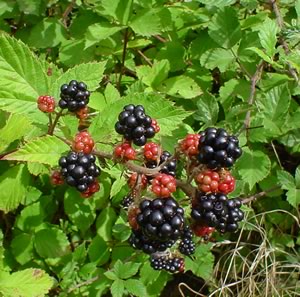
Blackberries

Contrarily to what some linguists think, Galician-Portuguese silva, silveira (collective) 'bramble (Rubus)' is unrelated to the homonymous Latin silva 'forest' (which regularly gives Romance selva), but it's cognate to Leonese silba 'service berry', silbar, silbal (collective) 'service tree (Sorbus domestica)'2.
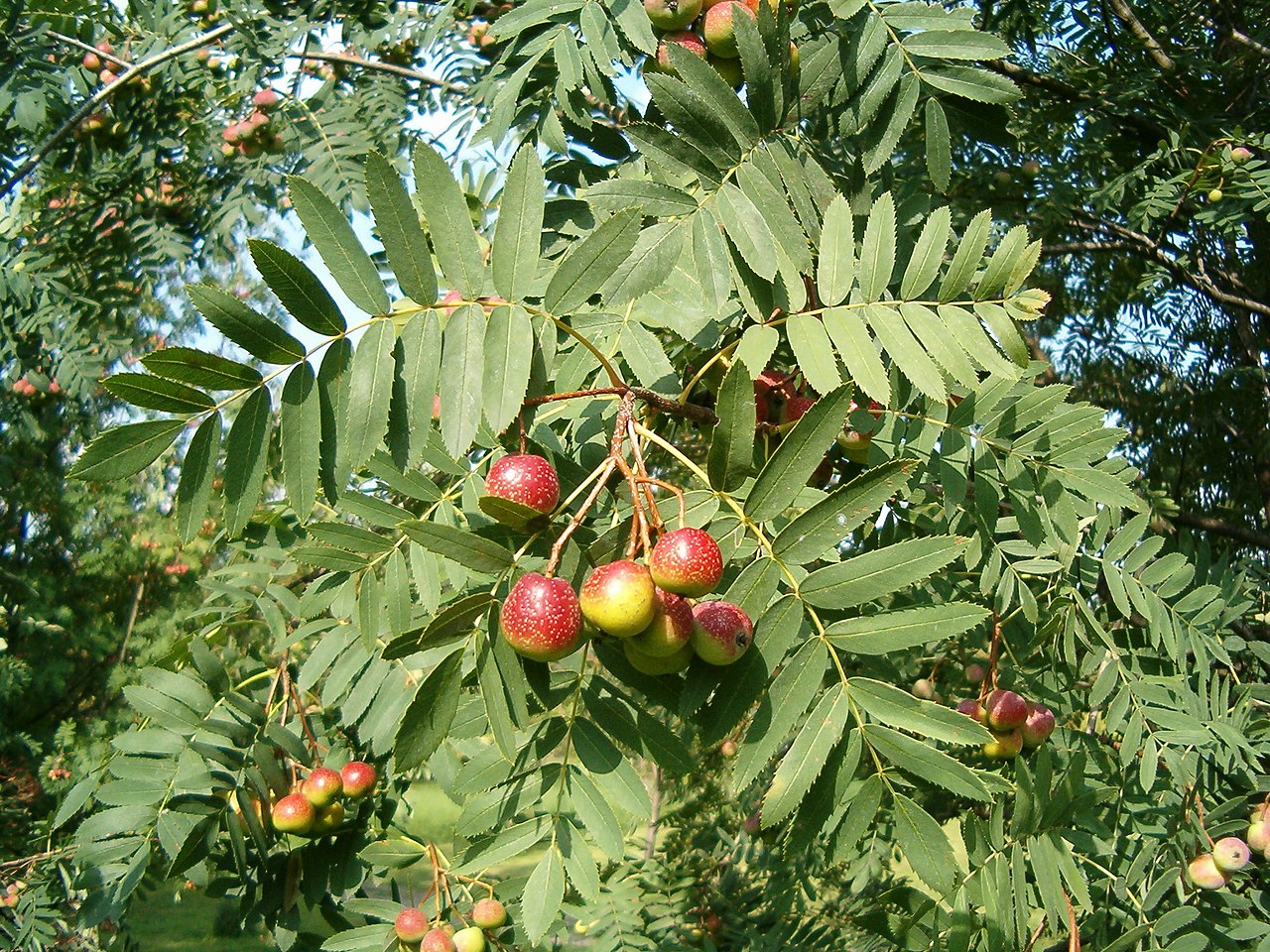
Service berries

This is a substrate loanword *silba1 with parallels (through lambdacism) in Romance serba 'service berry'3 (Catalan serva, Occitan sèrba, Spanish serba, jerba, sierba id., serbal, sierbal, Catalan servera, server (collective) 'service tree'4), Lithuanian serbentà 'currant (Ribes)' and dialectal Russian serbalína, serberína 'rose hip', sor(o)balína 'bramble'5, Latin sorbus 'service tree' (Spanish sorbo), sorbum 'service berry', from which derive Leonese (Liébana) suerbaFrench sorbe id., sorbier, Galician sorbeira, solveira (collective), Leonese  (Liébana) suerbal  'service tree'.

Although these forms show the typical IE ablaut e ~ o6, we also can find variants with /u/ vocalism: Leonese (Liébana) surba 'service berry', surbu (collective) 'service tree' and regional Spanish (Álava, Bureba, High Rioja) zurba, zurbia 'service berry', zurbal, zurbial, surbial (collective) 'service tree'. 

________________________________________________________ 
1 The shift -lb- > -lv- is regular in Portuguese.
2 J. Oria de Rueda et al. (2006): Botánica forestal del género Sorbus en España, in Investigación Agraria. Sistema y recursos forestales, vol. 15, nº 1,  p. 166-186.  
3 The proposed connection (Pedersen) with Celtic *swerwo- 'bitter' (Old Irish serb, Middle Welsh chwerw) can be ruled out. 
4 The forms serbo, jerbo, selbo, jelbo are the product of a contamination with sorbo.
M. Vasmer (1955): Russisches Etymologisches Wörterbuch, p. 697.
In fact, some Indo-Europeanists reconstruct a protoform *serbh- ~ *sorbh-.

16 August 2015

Tartessian Aiburis (updated)

Tartessian aiburis /Aiburis/ appears at the beginning of a funerary inscription (J.3.1) and is frequently interpreted as an anthroponym whose second element -ris would correspond to Celtic *-rīxs 'king' > -rix, which in fact is the most frequent element in Gaulish anthroponymy1. However, the first element aibu- (likely reflected in Iberian aibe), doesn't have a clear Celtic etymology, although it appears in the Gallaecian theonym Aebosocelensis2 and possibly also the toponym Aipora (modern Évora)3.

Prósper proposes a link to Greek aipús 'steep, craggy', aípos 'hill, crag', whose etymology is disputed4. If the labial stop comes from a labiovelar, we could compare it to the Italic toponyms Aequāna, Aequum Faliscum and Aequimelium (a village on the hillside of the Capitoline), the latter being a calque of the Gallaecian form. Although homonymous to Latin aequus 'equal; fair, even' < *aikʷo-, we can hardly expect Aequimelium to mean 'confraternity hill' or the like.

On the other hand, we've got Gallic (Gaulish) *aikʷo-randā 'boundary' as the source of the toponyms Aigurande, Eguérande, Eygurande, Iguerande, Ingrande(s), Yvrande(s), La Guirande, Eurande, etc5. The first element *ekwo- has been alternatively linked to Latin aqua 'water' (absent from Celtic) or aequus, but in my humble opinion it would make more sense to be a foreign loanword related to the Italic toponyms. 
_________________________________________
1 X. Delamarre (2008): Dictionnaire de la langue gauloise, 2nd edition, pp. 259-260.
2 B.Mª. Prósper (2000): Lenguas y religiones prerromanas del occidente de la Península Ibérica, p. 112.
3 J.T. Koch (2013): Celtic in the South-west at the Dawn of History, 2nd edition, p. 141.
4 P. Chantraine (1968): Dictionnaire étymologique de la langue grecque, p. 37-38.
5 X. Delamarre, op. cit., pp. 163-164.

30 July 2015

Basque (k)abia 'nest'


The Basque word for 'nest' appears with variants such as abia (B), habia (Z), kabia (G), kafia (G, HN), abira (S), abi (B), kabi (G, HN), api (G, HN), aapi (G). For this word, Mitxelena -the founder of modern Vascology- proposed more than 50 years ago an etymology from Latin cavea 'cage', which turns to be semantically inadequate.
 
By contrast, I propose a loanword from Celtic *āwjā 'brood; nest', a femenine form corresponding to the masculine *āwjo- 'egg' (Old Welsh ui, Middle Welsh wy, Middle Breton and Old Cornish uy)1. Therefore, both k- and -r- in some of the Basque forms would be epentic.


On the other hand, the forms abe (B) 'honeycomb', kabe (*L) 'nest; beehive' are the result of a semantic contamination with derivatives of Romance *kofanu 'deep basket' (Latin cophinus) such as Biscayan abao, abau 'honeycomb' and Bearnese càben 'beehive'. The semantic drift can be explained because artificial beehives in the shape of a deep basket are used in some places.
_____________________________________________________________________
1 R. Matasović (2008): Etymological Dictionary of Proto-Celtic, p. 50.

09 July 2015

Etruscan viscri 'penis' (updated)


Italian (Tuscan) bischero 'peg (on a string instrument); fool, idiot' derives from Etruscan viscri 'penis', attested in a votive inscription: eti viscri ture Arnθ Alitle Pumpuś (TLE 685) '... gives this penis', engraved on a figure of a man offering his male organ found at Paterno di Vallombrosa (Arezzo)

Although many specialists have linked the Etruscan word to Latin scus, vīsceris 'entrails' (itself a word of problematic etymology), I think the latter would correspond to Etruscan visc 'center' (see here). In my opinion, viscri would be an Italic loanword akin to Latin virga 'twig, rod' (with rhotacism) < *wizg-ā, from a lexeme *wizg- also attested in Germanic *wiskō 'bundle, besom'. The semantic shift 'rod' > 'penis' also happened in Spanish
verga < Latin virga.

24 June 2015

Basque ol(h)a 'forge, foundry'


Basque ol(h)a 'forge, foundry; workshop' is a word conflated with its homonymous 'hut; dwelling' (geographically restricted to a few dialects), a confusion also extending to the widespread toponymic suffix -ola1However, upon a closer scrutiny they reveal themselves as two different words. Firstly, Roncalese õla 'hut' has a nasal vowel, a remnant of a former initial nasal consonant. And secondly, the respective derivated verbs are different, as on the one hand we've got ol(h)atu (LN, Z) 'to hit with violence', and on the other, olhatü (Z) 'to stay on huts; to go to the pastures (in transhumance)'.

I think the Basque word would be a loanword from Celtic *ordā (f.) 'hammer' (Middle Welsh orth, Breton orz)2, possibly through retroflexion of the dental stop (as in Sweden and Norwegian), which ultimately evolved into a lateral. However, as no plausible IE etymology can be posited for the Celtic word, a non-IE origin is likely. A likely cognate would be Etruscan urθan- 'to make, to manufacture', attested in the past form urθanice '(he) made'. 

This way, we're left with a Tyrrhenian verbal root *ur-d- which I'd link on the one hand to IE *wer-g´- 'to work'3 (zero Ablaut), where IE *-g´- ~ Tyrrhenian *-d-, and on the other to Urartian ur-/or- 'to make, to work'4, which Diakonoff-Starostin4 relate in turn to Nakh-Daghestanian *=ahwV(r) 'to do' (NCED 1826).
___________________________________________________________________
1 Compare for example Loiola 'pottery', from lohi 'mud', and Gisasola 'broom bush', from (g)isats 'broom'.
2 There's also a masculine form *ordo- (Old Irish ord, Gaulish Ordo-). See R. Matasović (2009): Etymological Dictionary of Proto-Celtic, p. 300.
3 Incidentally, the amateur linguist Gianfranco Forni (who regards Etruscan as an IE language) derives urθan from an IE participle *h3er-to- 'risen' < *h3er- 'to rise' (Latin orior). However, to me this is not only semantically questionable but also phonetically inconsistent, as it wouldn't explain the voiced stop in Celtic, of whose connection with the Etruscan verb he's of course unaware.
4 N. Diakonoff & S. Starostin (1986): Hurro-Urartian as an East Caucasian Language, §163.

06 April 2015

Basque maite 'love, affection; dear, beloved' (updated)


Alhtough Basque maite 'love, affection; dear, beloved' has been since long suspected to be a Celtic loanword, the suggested etymon (Old Irish maith 'good' < Proto-Celtic *mati-1) is in my opinion semantically inadequate2.

On the other hand, we've got Galician neitegada 'expressive demonstration of affection or tenderness', presumably a Gallaecian substrate loanword from Proto-Celtic *neito-3 > Welsh nwyd 'passion, emotion', Old Irish nia 'warrior, champion', archaic gen. sing. Neth (Ogam NETTA-, -NETTAS)4. We've also got Iberian neitin 'dear', often found in the epistolary formula neitin iunstir 'Dear Sir'5

This way, the Basque word would be derived from an apophonic Celtic variant *noit
ā with secondary labialization of the initial nasal as in Roncalese moite 'love, tenderness'.
_____________________________________________________________
1 R. Matasović (2009): Etymological Dictionary of Proto-Celtic, pp. 259-260.
2 Koldo Mitxelena (1977): Fonética histórica vasca, p. 526, adduces the formal parallelism between Old Irish an-as maith la cách 'what each one deems good' and modern Basque bat-bederak maite duena 'what each one loves' (formerly bat bederak onhesten duena, with onhesten 'to be loved', lit. 'to esteem good') as an example where maite was equivalent to on 'good'.
3 This is an IE lexeme *neiH- 'to shine' also found in Proto-Celtic *neibo- Middle Welsh nwyf 'strong feeling, passion, desire', Old Irish níab 'vigour'. There's also an apophonic variant *noibo- reflected in Old Irish noíb- 'holy', Gaulish Noibio. See R. Matasović (2009): op. cit., p, 286. 
4 N. Zair (2012): The Reflexes of the Proto-Indo-European Laryngeals in Celtic, pp. 232-233. See also R. Matasović (2009), op. cit., p. 291.
5 Iberian iunstir has been linked by some authors to Basque jaun 'sir', likely a fossilized participle meaning 'exalted'. See R.L. Trask (2008): Etymological Dictionary of Basque (unfinished), p. 242. However, Miguel Beltrán Lloris (1974): "La palabra ibérica Iunstir, el plomo de Alcoy y algunos problemas de vasco-iberismo" en Homenaje a D. Pío Beltrán. Anejos de Archivo Español de Arqueología VII, pp. 21-72, proposed its meaning was 'desired'.

10 October 2014

Is really Tartessian a Celtic language? (newly updated)


When Koch's first book appeared in 2009 (the second edition came in 2013), launching his theory Tartessian was a Celtic language, I was enthusiastic. However, by the time he published his second book (2011) I had reached to the conclusion his interpretations were contrived as well as inconsistent.

A major difficulty regarding the Tartessian corpus is the semisyllabic SW script (where vowels are redundantly noted) hasn't yet been fully deciphered and thus the exact value of some signs is still unknown or problematicFor example, Koch assigns the sign H (Phoenician het, Greek epsilon) to the Proto-Celtic voicess bilabial fricative [ɸ] (almost universally lost in historical Celtic languages) coming from IE *p, as in e.g. HatªaneateHowever, the correspondence between Tartessian Haitura1 and Iberian baiduŕa2, the later seemingly related to baides 'witness', in turn derived from IE *weid- 'to see; to know (as a fact)' (cfr. Celtiberian ueizos), points to the the value /w/ (Greek digamma).

If this is correct and the word is native to Tartessian, it would indicate it's an IE language although certainly a non-Celtic one. A good possibility would be the Paleo-European (after Krahe's Alteuropäischesubstrate identified by the Spanish Indo-Europeanist Francisco Villar in the ancient Iberian toponymy, where we find the lexeme *akʷā 'river'3 (see hereused as a suffix (e.g. Turaqua).

Regardless of the actual filiation of Tartessian, it's clear it had contacts with other languages spoken in Western Iberia, namely Gallaecian (Celtic) and Lusitanian (non-Celtic). For example, the segment lokºobºo /lugu-boclosely mimicks Gallaecian LVGUBO /Lugubo/, LVCOVBV(S) /Lucoubo/, dative plural theonym presumably referring to the gods Lug.
____________________________________
1 Translated by Koch as 'Lady of Baeturia'. See J.T. Koch (2011): The South-Western (SW) Inscriptions and the Tartessos of Archaeology of History, in Tarteso, El emporio del metal.
2 The signs for rothics /r/ and /ŕare reversed in the SW (Tartessian) and Southern Iberian scripts with regard to the Levantine one, upon which the usual transcriptions are based.
3 Not 'water' (cfr. Latin aqua) as commonly thought.

09 August 2014

Latin aqua 'water' (updated)


Latin aqua 'water' < *akw-ā (f.) is an interesting word with correspondences in Germanic *áxwō 'river' (Gothic ahwa, Old High German aha) as well as Celtiberian akua whose meaning is probably 'river' (cfr. tar akuai 'across the river' in Botorrita III1). Contrarily to what many scholars think, its original meaning isn't 'water' but 'river'2 and belongs to the Old European Hydronymy (OEH), a corpus first studied by Hans Krahe and more recently by Francisco Villar and which represents an older form of IE than the historically attested languages3.  


Apparently, *akʷā would be a derivated noun from the adjective *aku- 'quick, fast', found in Latin acupedius 'swift of foot' and accipiter 'hawk', the latter with cognates in Greek ōkýpteros, literally meaning 'swift flyer' (ōkýs 'swift', pterón 'wing'), and Sanskrit āśu-pátvan- 'flying swiftly'4. These correspondences suggest Paleo-European *aku- would correspond to late IE *ōu- 'quick' > Latin ōcior.

On the other hand, the geminate stop in accipiter would be the result of a sound shift -kʷ- > -kk- which I call Kretschmer's Law and of which are examples in Italoid (e.g. the Lusitanian theonym Iccona) and Celtic (e.g. *sukko- 'pig'). There're also traces of it in Vulgar Latin 'water', as reflected in the Appendix Probi (aqua non acqua).
_________________________________________________
P. de Bernardo Stempel (2007): Water in the Botorrita Bronzes and Other Inscriptions, in Palaeohispanica 7, pp. 55-69.
Despite so, it has been compared it to other 'water' words, both within the IE family and oustide, even up to the point of building upon it a "global etymology" (Ruhlen).
More specifically, its agglutinative morphology would correspond to the "IE I (pre-flexional)" stage proposed by Francisco Rodríguez Adrados. Of course, Vennemann's proposal of OEH being related to Basque must be rejected.
M. de Vaan (2008): Etymological Dictionary of Latin and the Other Italic Languages, p. 21.