Showing posts with label Latin. Show all posts

25 March 2026

Semitic *gam(a)l- 'camel'


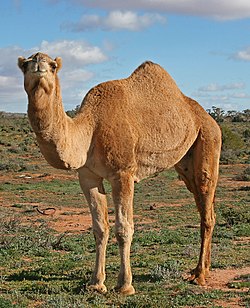
Semitic *gam(a)l- 'camel' is a widespread word which designates the dromedary of SW Asia and North Africa, first domesticated in Arabia before 2,000 BCE1, and was borrowed into Greek kámēlos and in turn into Latin camēlus


This appears to be a Wanderwort which originally designated some wild ungulate of the Eurasian steppes and which is also found in Baltic *kumel-iā̃, Slavic *kobɨ̄lā 'mare' and in Altaic (with metathesis) *kúlme 'a k. of ungulate': Turkic *Kulum 'foal', Mongolian *kulan 'Mongolian wild ass (Equus hemionus hemionus)'2Tungusic *ku(l)ma- 'maral (Siberian stag)/wapiti (Cervus canadensis)' and Japonic *kuáma 'foal, colt' aral' (EDAL 911).

A seemingly related Wanderwort for equids can be found in Caucasian *gwælV (~ -ɫ-) 'horse' (a Nakh-Tsezian isogloss) and which also designates the onager (Equus hemionus): Farsi gur 'Persian onager (Equus hemionus onager)', Hindi khur 'Indian wild ass (Equus hemionus khur)'; IE *gwold- 'foal, young of an ass' > Sanskrit gardabhá- 'ass'3Germanic *kult-a- 'colt' (English colt) an Basque zaldi 'horse'4, with assibilation of the initial velar. The latter has cognates in the Iberian antroponym formant saldu and Berber a-serdun 'mule'.


__________________________________
1 Another species of camel, the Bactrian camel, native to the steppes of Central Asia, was first domesticated before 2,500 BCE.
Borrowed by Turkic, where it designates the Turkmenian kulan (Equus hemionus kulan).
3 Tocharian B kercapo 'ass, donkey' is likely an early Indo-Arian loanword. See D.A. Adams (1999): A Dictionary of Tocharian B, p. 195-196.
4 Although some authors have proposed a link to thieldones 'a breed of Asturian ambling horses' (Pliny) < IE *del- 'to shake' (cfr. English tilt), in my opinion this is semantically unsatisfactory.

16 September 2025

Celtic *longā 'boat, vessel' (updated)


Celtic *longā 'boat, vessel' is attested in Welsh llong 'ship', Old Breton locou 'vessels, vases', Old Irish long 'vessel, (little) vase, ship', to which corresponds the Gaulish toponymic element Longo-1. There's also Cisalpine Gaulish (Todi) lokan /longan/ 'cinerary urn', an accusative form where /ng/ is rendered as k.

Although some authors have suggested a loanword (with reanalysis) from Latin nauis longa 'warship' (lit. 'long ship'), specialists such as Matasović2 think this is a genuine Celtic word without IE etymology, which I consider it to be a cultural loanword from North East Caucasian *leqˀV 'a k. of vessel' (NCED 1511), where the ejective stop became prenasalizedAlso related would be Latin lanx 'dish, plate'3, apprently borrowed from Etruscan in account of its /avocalism.

This lexeme was also borrowed into IE *lonko-/ā 'valley' > Lithuanian lankà ‘valley, rivermeadow’, Old Church Slavonic ka ‘gulf, valley, meadow, marsh’, Tocharian B leke ‘valley’, and Late Latin *lanca ‘depression, bed of a river’4, with a straightforward semantic shift.
_______________________
1 X. Delamarre (2008): Dictionnaire de la langue gauloise, p. 206-207.
2 R. Matasović (2009): Etymological Dictionary of Proto-Celtic, p. 244.
3 This meaning is reflected in Tsezian.
4 J.P. Mallory & D.Q. Adams (2006): The Oxford Introduction to Proto-Indo-European and the Proto-Indo-European World. 122.

10 October 2016

Latin costa 'rib; side, flank' (updated)


Latin costa 'rib; side, flank' has been traditionally linked by Indo-Europeanists to Old Church Slavonic kostĭ 'bone'1although more recently De Vaan considers this etymology to be dubious, among other reasons because of semantic mismatch2

In fact, the Slavic word is undoubtedly related to IE *h2osth1- 'bone', although its initial velar stop can't be accounted for in the mainstream model3. The amateur linguist Glen Gordon proposes an early borrowing from a femenine variant of Semitic *kˀa(w)ʃ- 'bow'4 (cfr. Phoenician qšt5)with a semantic drift 'bow' > 'rib' > 'bone'.

In most Romance languages except Romanian, the anatomical meaning of costa was transferred to diminutive forms (e.g. Spanish costilla, French côtelette), while the main word specialized into geographical meanings: '(hill) slope' (e.g. Spanish cuesta) and 'shore' (Catalan and Italian costa), which spread as WanderwortSpanish costa, English coast, Dutch and Swedish kust, German Küste, Danish kyst, etc. There are in addition Middle High German Gestade 'bank' and Old Irish ces 'flank, rump steak', césán 'flanks', which can't be readly derived from costa although they're semantically and phonetically close. 

This makes me wonder if all these words could be Semitic borrowings akin to or from Phoenician qsˁt 'edge, limit' (f.)6 < Semitic *kˀītʃˀ 'end, to finish' < Afrasian *kˀajatʃˀ- (HSED 1562), with Latin and German having got the femenine variant and Goidelic the masculine one.
____________________________________________ 
1 A. Ernout & A. Meillet (1959): Dictionnaire étymologique de la langue latine, p. 146.
2 M. De Vaan (2008): Etymological Dictionary of Latin and the other Italic Languages, p.140. 
3 Gamkrelidze-Ivanov regard these as different reflexes of a former *qʰ. See Gamkrelidze & V.V. Ivanov (1995): Indo-European and the Indo-Europeans, pp. 111-113.
Mª J. Estanyol (2008): Diccionari abreujat fenici-català, p 113.
6 Mª J. Estanyol, op. cit., p 112.

07 October 2016

Latin voltur 'vulture' (updated)


Latin voltur, vultur 'vulture' is linked by scholars such as Mallory-Adams to Greek blosyrós 'terrible, fearsome' and blosyrōpis 'grim-looking' (seemingly from Aeolic in account of *w- > b-), thus reconstructing an IE protoform *gʷl̥tur-1.

However, the Latin word is most likely a loanword from Etruscan velθur 'hawk, falcon', attested in the gentilic Velθur-na, which is likely associated to the city of Capua (cfr. capys 'hawk, falcon'). On the other hand, if the ancient toponyms Vulturnum (Castel Volturno) and Vulturnus (Volturno)2 are actually related to vultur, then we could add too Etruscan velθ 'underground, netherworld', velθu-na 'human', velθ-ra 'infernal tunnel' (Moretti) to this etymology, pointing to a Tyrrhenian protoform *wVrd- 'underground'.

This would be also the origin of Greek Ōrth(r)os, the name of an infernal dog, although from a different substrate language.
_______________________________________________________________
1 J.P. Mallory & D.Q. Adams (2006): The Oxford Introduction to PIE and the PIE World, p.145.
2 Hence (ventus) Vulturnus 'SE wind' > Spanish bochorno 'foehn, sirocco'.