Showing posts with label Italoid. Show all posts

24 July 2014

French bourbe 'sludge' (updated)


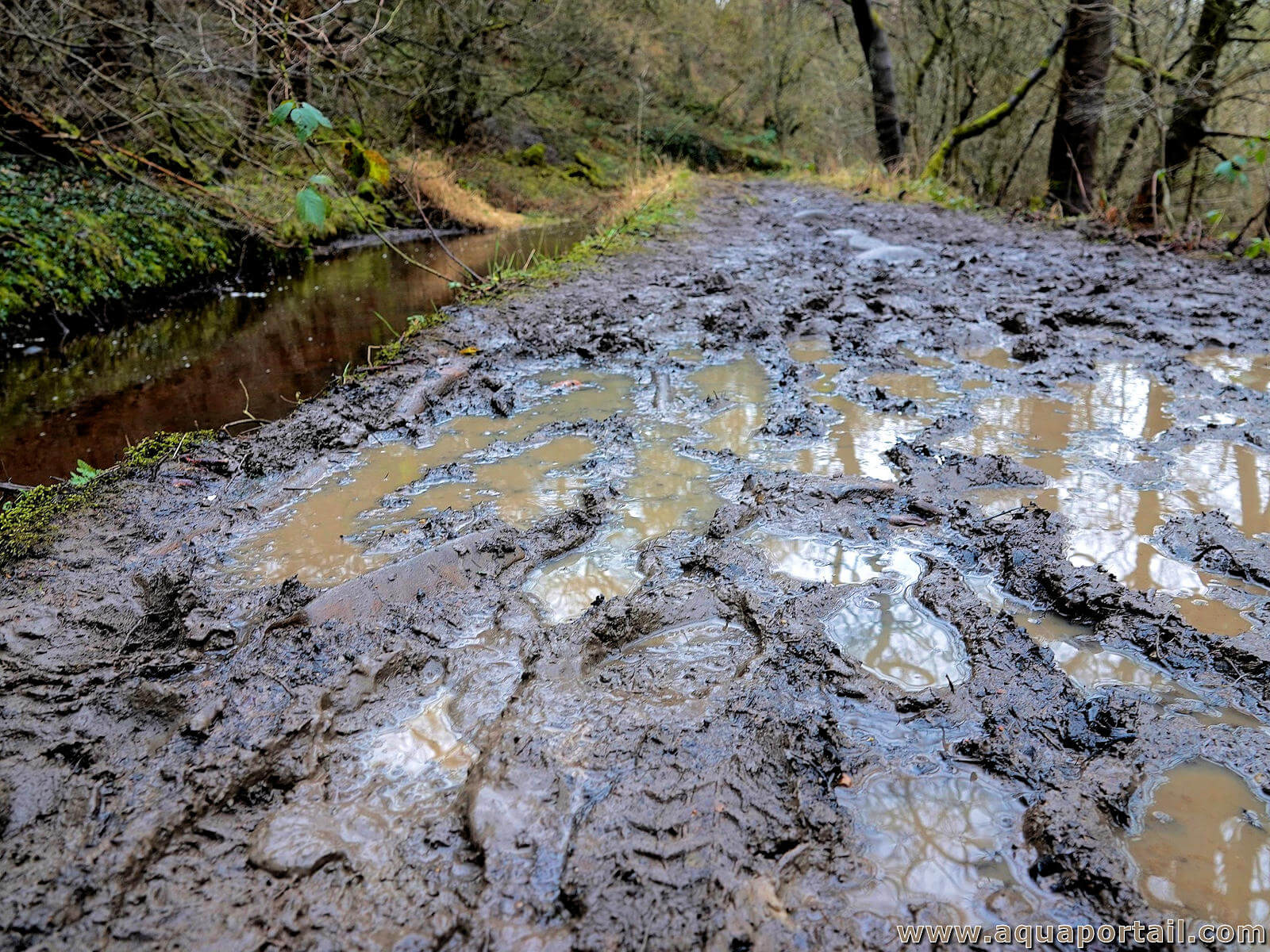
French bourbe 'sludge' (collective form bourbier) designates a kind of dark, thick mud deposited by stagnant or waste waters and surely derives from 
Gaulish *borwā (f.), whose supposed meaning 'hot, boiling spring' accroding to standard dictionaries, which link it to Welsh berwi, Breton bervi 'to boil'1. 

However, in my opinion this etymology is semantically unsatisfactory, and I'd prefer a substrate loanword from Baltic *purwā > Lithuanian pũrva 'smudge, dregs', Latvian pùrvs, purve 'morass, swamp', a word with parallels in Indo-Aryan: Sanskrit púrīṣa- 'crumbling or loose earth, rubbish; feces, excrement, ordure', Sinhalese puraṇa 'fallow or waste land'. 
______________________________
1 X. Delamarre (2008): Dictionnaire de la langue gauloise, pp. 82-83.

02 September 2013

Basque otso 'wolf' (updated)

Basque otso 'wolf' apparently derives from Aquitanian OSSON, OXSON1, where XS probably reflects an apico-alveolar affricate like the one found in modern Basque. There're also the Iberian onomastic element ośon and the "Tartessian" toponym Osson-oba 'River of wolves', whose second member is probably an Italoid toponymic element (e.g. On-oba) cognate to Lithuanian upė2.

My colleague Miguel Carrasquer links this word to Berber *wVʃʃVn 'jackal', in turn linked to Egyptian wnʃ 'wolf' by Militarev. I regard this and other substrate loanwords as remnants of a Paleo-Berber language once spoken in the Iberian Peninsula. This would possibly be reflected in the distribution of Y-chromosome haplogroup E-M81, native to NW Africa but found also in some areas of the Iberian Peninsula (especially on the west), with a strong peak among Pasiegos of Cantabria, an ethnical group of trashumant shepherds3.

Distribution of Y-chromosome haplogroup E-M81
______________________
1 J. Gorrotxategi (1984): Estudio sobre la onomástica indígena de Aquitania, p. 250-251.
2 F. Villar (2000): Indoeuropeos y no indoeuropeos en la Hispania prerromana.
3 Attempts to explain this as a result of the Muslim conquest (8th century AD) can be dismissed.
19 March 2013

Rhaeto-Romance karmún 'weasel'


Following Meyer-Lübke (REW 1700), the French linguist Xavier Delamarre1 proposes Gaulish *karmon- as the source of Rhaeto-Romance (Surselvan) karmún 'weasel', although personally I think the source language would be Italoid.

This is a regional IE word *k´ormon- 'weasel, ermine' found in OHG harmo, Lithuanian šarmuõ 'wildcat, ermine', šermuõ 'weasel, ermine' as well as Basque armindderi (Aezk), armonddegi (HN), ergoniri (HN), ergoneri (HN), ergenore (HN), erbindori (*L), erminori (HN), erbiñore (G), erbiñude (G), erbiñure (G, L) 'weasel' (a compound whose second member is unknown2), with loss of the initial stop due to Martinet’s Law.

Probably related is Mongolian *keremü 'squirrel', borrowed into Tungus keremun (MT 123)3. There’re also Turkic *Küŕen, Mongolian *kürene 'ferret, weasel' (EDAL 1105) and Tungusic *gurma-/ *gurna- 'hare; squirrel; ermine' (EDAL 572), wrongly linked to different words in other Altaic languages4.
________________________________
1  X. Delamarre (2008): Dictionnaire de la langue gauloise, p. 105.
2 The forms erbi-unide (Bazt), erbionide (HN) are the product of a folk etymology from erbi 'hare' and unide 'wetnurse'.
3 G. Doerfler (1985): Mongolo-Tungusica.
4 In fact, the latter is absurdly paired to Turkic and Korean words meaning 'antelope; deer'.

01 July 2010

Knives and ploughs

According to the traditional view, English knife, from Germanic *knība-z 'knife' (with no native IE etymology), is a Wanderwort which spread from Old Norse into Old English and other Germanic languages, as well as Old French quenif, quanif 'pocket knife', (and in diminutive form) Occitan ganivet, Aragonese cañivete and Basque kanibet, ganibet, kanabita, gaiñibeta, ganabeta, kanit, gaminta 'penknife'.

However, the German linguist Theo Vennemann1 (see my earlier post) reversed the propagation direction, considering Basque kanibet to be the original form, as a compound of kana 'cane' (a loanword from Latin canna) and bedoi 'pruning shears'2, a dialectal word of limited extension. But (unknowingly to him) the latter is a loanword from Gaulish uidubion 'hoe' (glossed as Latin vidubium), a compound from uidu- 'wood' and -bion < Celtic *bi-na- 'to hit, strike' < IE *bhejH-.  This root is reflected in Germanic as *bī́ɵla-, *bīdla- 'knife, sword, ploughsare' > English bill.

My own proposal is that Latin novācula 'razor, knife' (Portughese navalha, Spanish navaja, Catalan navalla, Aragonese novalla) < *kne-wa-tlā, traditionally derived from IE *ksew- 'to rub, to whet'3, is actually a reflex of IE *kneH2- 'to scratch, to scrape'. This etymology can also explain Basque nabas- 'plough' (in compounds)3 < *knā-wa-z and Germanic *knība-z < *knē-wa-z as borrowings from some IE language (possibly Italoid) where IE *w gave b. 

The semantic shift from 'knife' to 'plough' can also be observed in the descendants of Latin culter 'knife' > Occitan coltre, French coutre, Italian coltro 'ploughshare', Basque golde 'plough', the original meaning being transferred to the diminutive cultellum > Galician coitelo, Spanish cuchillo, Catalan coltell 'knife' (the latter form being displaced by ganivet).

Another interesting Basque word is saratu 'to hoe', a loanword from IE *sºrp- 'sickle; to cut' (Latin sar(r)iō 'to hoe (vine)' < *sarpiō.)
______________________
1 Zur Etymologie der Sippe von engl. knife, franz. canif, bask. kanibet*, in Europa Vasconica, Europa Semitica (2003), pp. 427-452.
2 Also Bearnese bedui. See García de Diego, Diccionario etimológico español e hispánico (1985), pp. 1063-1064.
3 Considered by many Indo-Europeanists to be an extension of IE *k´es- 'to cut'.
4  There is also the Bearnese hapax naves '(large) knife'.

01 May 2010

Strawberry fields forever

Starostin reconstructs a Paleo-Eurasian root *NEk’rV 'thorny bush' > Altaic *ńíkrV 'a k. of thorny tree', from which I derive Paleo-European *ag´ºr- (Gaulish agraniō- 'sloe, fruit of the blackthorn', English acorn1, Latin agresta 'green grape', Greek ágrios 'wild'), with loss of the initial nasal. Its IE native counterpart would be *dhreg´h- 'sloetree, blackthorn'2 (Celtic *dragenā 'sloe, fruit of the blackthorn'3, Albanian drédhë 'strawberry'). Greek hrá:ks, hró:ks 'grape' < *srāg-, is probably a Thracian loanword from the same root.

Paleo-Eurasian *bVrdzV 'thorn' is the origin of Kartvelian *bardzg-/*burdzg(a) 'thorn, thorny plant'. The sibilant *dz is reflexed as *g´ in IE *bhrag´- 'strawberry' > Lithuanian brãškē 'garden strawberry', Latin frāgum 'strawberry'4 and as *g´h in *wreH2g´h- 'thorn' > Celtic *wragi- 'needle', Lithuanian rãžas 'dry stalk, stubble; pronk of fork', Greek hrákhos 'thorn-hedge', hrákhis 'spine, backbone'.

Altaic *núŕi (˜ -e) 'a k. of berry, grape'5 is related to Hittite muri- '(bunch) of grapes' and IE *moro- 'blackberry'.
_________________
1 Indo-Europeanists usually group this with Lithuanian uga 'berry', Old Church Slavic jagoda 'fruit', vin-jaga 'grape', but I prefer to group the Balto-Slavic forms with Latin ūva 'grape', thus reconstructing *H3gwh-ā 'berry'.
2 Found (with simplification of the initial cluster) in Basque lahar, nahar 'blackberry (Rubus fructicosus); buckthorn (Rhamnus cathartica); caltrop (Tribulus terrestris)'.
3 Related to this is *dhren- 'cornel cherry' (Old High German dirn-baum, Russian derën) ~ *tºrnu- 'thorn'.
4 Usually though to be derivated from *srāg-. French fraise, Spanish fresa 'strawberry' is probably an Italoid loanword from the same root (Italoid is a "satem" language with *bh- > f- like Latin). Basque has araga 'strawberry' and arakatz 'gooseberry'.
5 Notice than the supposed Korean cognate *nùrúk 'yeast' presented in the database doesn't correspond to this root but to *ńjuŕge 'a k. of weed' < Paleo-Eurasian *nUŕV 'grain, corn'.

01 March 2010

Celtic and IE substrates

There's toponomastic evidence of IE substrate languages spoken in parts of Europe before the historical attested languages. One of them is the Old European hydronymy language (Krahe's Alteuropäische). OEH looks like an archaic IE language (even more than Anatolian), with predominance of the vowel /a/ and lack of inflection. In this way, it would reflect the stage called IE I or "pre-flexional" by Rodríguez Adrados1.

I adscribe to this substrate Celtic *nantu-/*nanto- 'stream, valley', from PIE *dhen- 'to run, flow' (cfr. Latin fōns, fōntis 'spring, source'), with assimilation of the initial dental to the following nasal in the source language (that is, PIE *dh- > *d- > *n-).

Another IE substrate found in SW Europe is Italoid (aka Sorotaptic), which according to linguists Joan Coromines and Francisco Villar was somewhere between Baltic and Italic in the IE dialectal cloud. 

In his last book, Prof. Koch of the University of Wales postulates Tartessian (found in inscriptions of SW Iberia dating back to the 7th century BC) as a Celtic language with "aberrant" features like uar- < *ufor- 'over, on', with /a/ instead of the expected /o/ (cfr. Old Irish for). This apparent contradiction could be explained if Tartessian had an Italoid substrate.

According to Villar, IE had a 4 vowel system /i, E, A, U/ until the reduction  of *H2e > a introduced a new central vowel in the system. In some languages (Celtic, Italic, and Greek), /a/ pushed /A/ back into /o/, while in Italoid (and also Germanic, Balto-Slavic, Indo-Iranian) they merged into a single vowel.

There's an Italoid lead inscription (now lost) found in Amélie-les-Bains/Els Banys d'Arles (Roussillon) which has been studied by Coromines2. It's a votive text dedicated to the nymph deities called KANTAS NISCAS. The first word derivates from PIE *kwento- 'holy' and the second one is the Iberian counterpart of Basque neska 'girl' < *neś-ka3 < PNC *nusA (˜ -o-) 'daughter-in-law'.

Latin has loanwords from Italoid like vagus 'wanderer' < IE *weg´h- 'to carry (in a vehicle)'.
___________________
1 See for example his Nuevos estudios de lingüística indoeuropea (1988).
2 Els ploms sorotàptics d'Arles, in Entre dos llenguatges, vol. II, p. 143-146 (1976).
3 Iberian niś is found as an anthroponym formant in inscriptions and -ka is a diminutive suffix.

22 December 2009

Hair and wool

Basque bil(h)o 'hair, mane' is an interesting word. In compound with the verb utzi, itzi 'to leave' it gives biluz 'naked', biluzi 'to get naked' (with many variants: biloiz, bilaiz(i), bileiz(i), biluxi, buluzi, buluxi).

The etymology of this word has puzzled more than one Vascologist, specially given its similarity to Latin pilus '(a single) hair'. But a borrowing can be safely discarded due to phonetical reasons, because Latin -l- would have given -r- in Basque.

An alternative source from Latin villus 'tuft, lock of hair; hair' (probably an Italoid loanword parallel to Baltic *wil-na 'wool') was then proposed, but I find this unrealistic. My own view is that Basque bil(h)o and Latin pilus are one and the same Cantabrian word, ultimately related to PNC *p’VħVɫV 'feather; mane' (an etymology proposed by Bengtson).

Other 'hair' words found in IE languages come from this Vasco-Caucasian root. In particular, Greek púligges [pl.] 'hairs of the body' and Sanskrit pulakās [pl.] 'bristling hairs of the body' are similar to Nakh *pēla-k’ 'feather'.

The Tyrrhenian counterpart of bil(h)o is Basque ule 'hair', ile 'hair, wool', with several doublets in compounds. The meaning 'wool' suggested to some authors a possible borrowing from Gothic wulla < Proto-Germanic *wullō(n), but this rather makes me think PIE *w̥lH2neHa- 'wool' could be in fact a very old Vasco-Caucasian loanword: *p’VħVɫV > *bVlħV > *wVlħ-, with merging of b/w in PIE (where the voiced labial stop is very rare).

06 November 2009

The magpie and the heron

There's a class of onomatopoeic roots *kVr- which designate several types of birds.

For example, Aragonese garza, Catalan garça, Italian gazza 'magpie' < *karkea is an Italoid loanword from PIE *ḱarhk-eh2- 'magpie' (Lithuanian šárka, Russian soróka)1, akin to Turkic *KArga 'crow' and PNC *q’q’HVrVq’V 'a k. of bird (magpie; eagle-owl)'.

The homonymous Spanish garza 'heron'2 is a loanword from Celtic *kor(x)sā 'heron, crane', probably through a Cantabrian intermediate *karsa. A similar root can be found in Latin ardea 'heron' < PIE *h1orhd-eh2- 'heron', akin to Turkic *Kordaj 'pelican; swan'.

Latin corvus 'raven' is a loanword from Afrasian *ɣurVb- 'crow, raven', and cornīx 'crow' is akin to Uralic *kOrnV 'raven'.
_____________
1 Probably also Celtic *kerkā 'hen'.
2 In Spanish, 'magpie' is urraca.

01 November 2009

Spears and poles

Basque langa 'enclosure, rustical door; bar, catch (on a door or window)'1 is related to Occitan/Catalan tanca id.2, with a sound shift *t- > l- in Proto-Basque.

This is an Italoid substrate loanword whose etymology is IE *tengh-s- 'pole' > Latin tēmō 'steering-wheel; spear (of a cart)' and Old English þīsl 'wagon-pole, shaft'3. This IE root is a -n- infixed variant of *(s)teg- 'pole, post' (English stake), which in turn is related to PNC *dwɨq’(w)V: 'log, stump'.

This Vasco-Caucasian root is found as a Vasconic loanword in Spanish taco, Catalan tac 'block of wood, wedge; wooden stick', French taquet (diminutive form) 'block of wood, wedge', as well as in Basque haga 'pole, stake'4. The Tyrrhenian variant is found in Spanish tocón (augmentative form), Portuguese tôco 'stump' and also in Catalan soca, French souche 'stump', Old French choque 'log' and Spanish zoquete (diminutive form) 'block of wood; dumb, stupid'5, with assibilation of the initial dental.
___________
1 Mitxelena derives it from Romance *planka 'plank, board'.
2 Coromines proposes a derivation from a hypothetical Sorotaptic verb *tankō- 'to close'.

3 See Mallory & Adams (2006), p. 249.
4 There's also non-standard Basque tako 'circular piece of wood' and taket 'stake, wedge; dump, stupid'.

5 Coromines considered this word to be an arabism. What a zoquete!

Scabies and iron

English iron (and related forms in other Germanic languages) is a loanword from Celtic *īsarno- 'iron', whose origin is the IE adjective *H1ésH2r̥-no- 'bloody', derivated from *H1ésH2r̥- '(flowing) blood'.

Although nobody thought of it until now, *H1ésH2r̥-no- is also the origin of Spanish sarna 'scabies, mange', a pre-Romance word glossed by Latin authors. There're also Basque sarra 'rust, iron tartar'1 and Spanish sarro 'tartar, plaque', with assimilation -rn- > -rr-.

The source of this and other loanwords is an IE substrate language called Italoid by the Indo-Europeanist Francisco Villar2 and Sorotaptic by the Catalan linguist Joan Coromines3. According to them, Italoid shares isoglosses with Baltic and Italic in the IE dialectal cloud.
_____________
1 Only found in the Biscayan dialect, which also has sarna.
2 See Indoeuropeos y no indoeuropeos en la Hispania prerromana (2000).
3 Who has a quite different etymological proposal for this word.