 |
| Sloes |
Occitan agranhon, Aragonese arañón, Catalan aranyó 'sloe, fruit of the blackthorn (Prunus spinosa)' < Gallo-Latin *agraniōne-, is a diminutive form borrowed from Gaulish *agranio-. The Gaulish word is
also the source of Basque ar(h)an, which means 'sloe' in Biscayan1 but 'plum' in other dialects, as
well as the collective form arantza (B, G), arantze (L), arhantza (LN) 'thorn(bush)'.
A popular liquor made from sloes is called patxaran (Spanish pacharán), a compound from pattar 'liquor' which coalesced (popular etymology) with the High Navarrese name of the fruit, a variant of ba(i)saran (G), baixaran (S), maisaran (R), basahan (Z), paxaran (HN, Aezk, R), a compound from basa- 'wild' and aran.
 |
| A bottle of home-made patxaran |
A popular liquor made from sloes is called patxaran (Spanish pacharán), a compound from pattar 'liquor' which coalesced (popular etymology) with the High Navarrese name of the fruit, a variant of ba(i)saran (G), baixaran (S), maisaran (R), basahan (Z), paxaran (HN, Aezk, R), a compound from basa- 'wild' and aran.
The corresponding form in Insular Celtic is *agriniā (Old Irish áirne, Welsh eirin), although phonetic differences make impossible to reconstruct a single Celtic protoform. IE cognates are Germanic *akarna-/*akrana-/*akirna- 'acorn'2, Latin agresta 'green grape', agrestis and Greek ágrios 'wild', which have nothing to do with 'field' (Latin ager, Greek agrós) in despite of their resemblance.
 |
| Oak acorns |
The scarce attestation within IE and the semantic latitude point to a Paleo-European substrate loanword which I'd link (with loss of the initial nasal) to Uralic *nakrV 'cedar nut'3, and possibly also to Altaic *ɲíkrV 'a k. of thorny tree', Eskimo *(Nǝ)k[r]uʁa- (~ *Nǝkǝvʁa-) 'tree, spruce'.
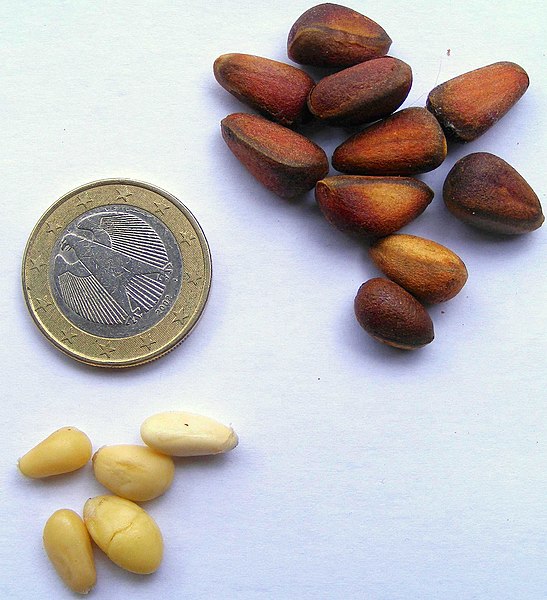 |
| Cedar nuts (with and without shell) |
_______________________________________________________
1 The Gipuzkoan form is txaran. In these Westernmost dialects, 'plum' is okaran, apparently from an anaptyctic form *akarann.
1 The Gipuzkoan form is txaran. In these Westernmost dialects, 'plum' is okaran, apparently from an anaptyctic form *akarann.
2 Pokorný conflated the Celtic and
Germanic words with Lithuanian úoga 'berry', OCS (j)agoda 'fruit', vin-jaga 'grape', which are better linked
to Latin ūva 'grape'.
3 The fruit of the
Siberian pine (Pinus sibirica) or Swiss pine (Pinus cembra).


