19 March 2013

Rhaeto-Romance karmún 'weasel'


Following Meyer-Lübke (REW 1700), the French linguist Xavier Delamarre1 proposes Gaulish *karmon- as the source of Rhaeto-Romance (Surselvan) karmún 'weasel', although personally I think the source language would be Italoid.

This is a regional IE word *k´ormon- 'weasel, ermine' found in OHG harmo, Lithuanian šarmuõ 'wildcat, ermine', šermuõ 'weasel, ermine' as well as Basque armindderi (Aezk), armonddegi (HN), ergoniri (HN), ergoneri (HN), ergenore (HN), erbindori (*L), erminori (HN), erbiñore (G), erbiñude (G), erbiñure (G, L) 'weasel' (a compound whose second member is unknown2), with loss of the initial stop due to Martinet’s Law.

Probably related is Mongolian *keremü 'squirrel', borrowed into Tungus keremun (MT 123)3. There’re also Turkic *Küŕen, Mongolian *kürene 'ferret, weasel' (EDAL 1105) and Tungusic *gurma-/ *gurna- 'hare; squirrel; ermine' (EDAL 572), wrongly linked to different words in other Altaic languages4.
________________________________
X. Delamarre (2008): Dictionnaire de la langue gauloise, p. 105.
2 The forms erbi-unide (Bazt), erbionide (HN) are the product of a folk etymology from erbi 'hare' and unide 'wetnurse'.
3 G. Doerfler (1985): Mongolo-Tungusica.
4 In fact, the latter is absurdly paired to Turkic and Korean words meaning 'antelope; deer'.

18 March 2013

Greek párdos, párdalos 'leopard' (updated)


Greek párdos, párdalos 'leopard' was borrowed into Latin pardus, later used with leo 'lion' in the compound form leo pardus, and it was semantically reanalyzed in Romance as an adjective 'blackish; brown', firstly referring to the spots of leopards and later generalized to other things1.

The Greek word has cognates in Indo-Iranian (Sogdian prwδnk, Pashto pāng 'panther', Sanskrit pdāku- 'tiger, panther'). A similar word can be found in Hittite parš-ana- 'leopard', corresponding to the Hattic genitive ha-prašš-un 'of leopard' and Persian pārs ~ fārs 'panther', in turn borrowed into Western Mongolian phars, bars 'snow leopard; tiger' and Old Turkic bārs 'tiger' (although some Turkic languages preserve the meaning 'panther'). This is also the probable source of Russian bars 'leopard'2.

Probably also related is Mongolian beltereg 'young of wolf' < *berteleg (EDAL 175). The form börtü (berte) činua is translated as 'multicolored wolf (name of the legendary ancestor of Chinggis Khan)' and börtü is glossed as 'mottled, speckled, grey', in a similar way to Latin pardus.

Gamkrelidze-Ivanov consider this to be a substrate loanword from some language of Asia Minor, whose alternation d ~ s would reflect a dental fricative3.  In my opinion, the source would be North-east Caucasian (Nakh-Daghestanian) *bħertsˀi(~ -e) 'wolf, jackal'4, linked by Starostin to Sinitic *prāts 'a k. of mythical predator'.
____________________________
1 J. Coromines (1973, 2008): Breve diccionario etimológico de la lengua castellana, p. 414.
2 T.V. Gamkrelidze & V.V. Ivanov (1995): Indo-European and the Indo-Europeans, p. 421.
3 T.V. Gamkrelidze & V.V. Ivanov, op.cit., p. 425-426.
4 Also related is the isolated Lezghian (Tabarasan) form barči 'tracking dog, bloodhound'.

13 March 2013

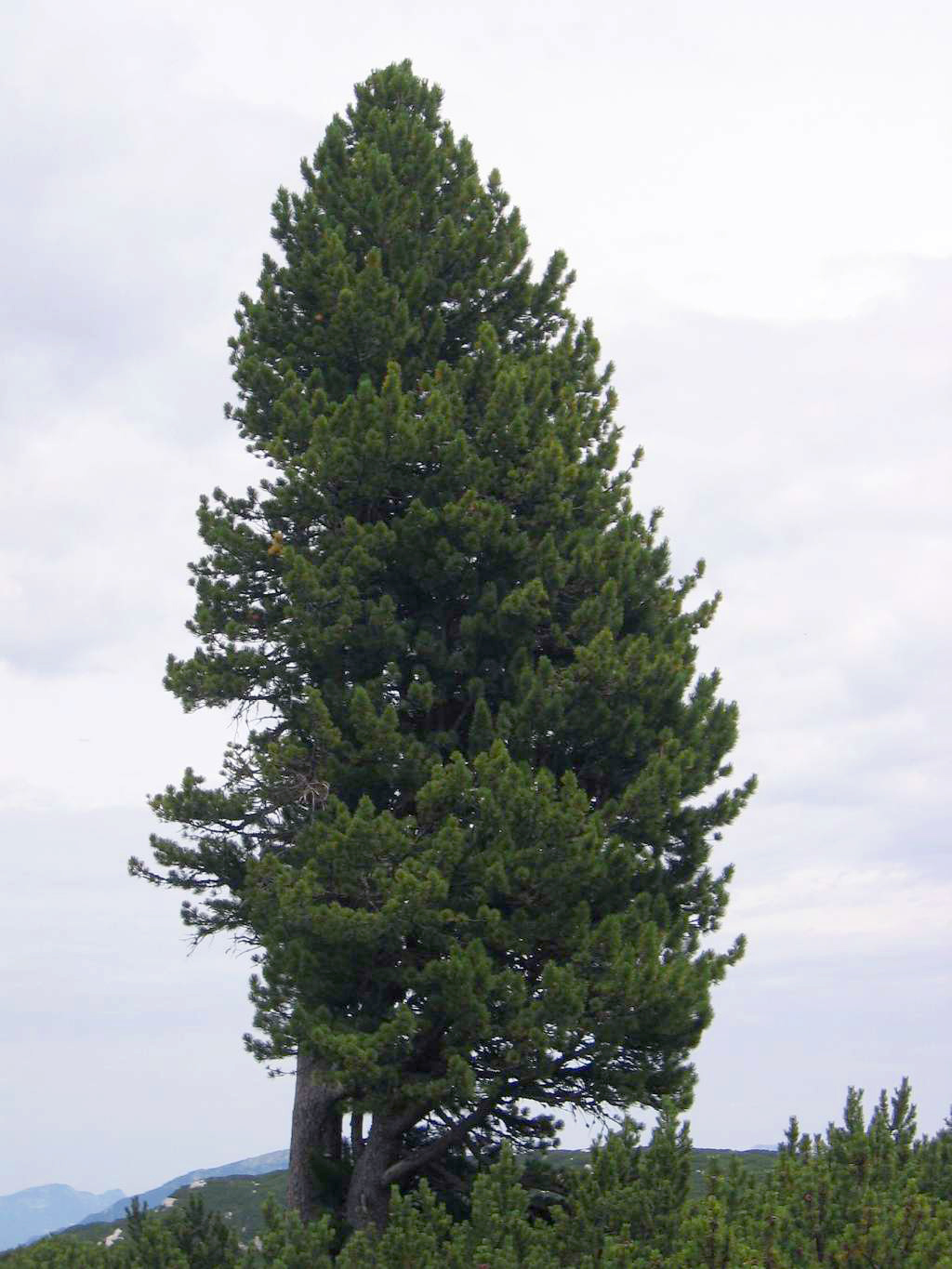
Italian cembro, cembra 'Swiss pine' (updated)

Swiss pine

Italian cembro, cembra, cirmolo 'Swiss pine (Pinus cembra)' is cognate to Friulan cirmul, Ladin cirum, zirm, Raetho-Romance ğèmber (Engadin), žember (Bergün/Bravuogn), Romanian zâmbru, and High German Zirbe, Zirbel, Zirbelkiefer. This would point to a substrate loanword *kemro- ~ *kirmo- which my colleague Marco Moretti considers to be of Tyrrhenian (Rhaetic) origin. 

Another name for the Swiss pine used in Switzerland is Arbe, Arve < *arbo-, with loss of the initial postvelar and denasalization.

For these words I'd propose a Vasco-Caucasian etymology from Caucasian *qq’wǝmV 'grain, fruit stone', Sino-Tibetan *kuam 'fruit (with) kernel', Yeniseian *ʔem- (~ x-) 'cone (of a coniferous tree)'.

Pine cone
 
This etymology would be also the source of Greek kônos 'cone', Altaic *tʃhumu 'seed; cone' (Mongolian, Tungusic)1 and Paleo-Basque *sini > Basque zi (S, Z), (R) 'oak acorn', with palatalization of the initial velar. 
 

_________________________________
1 Conflated in the EDAL with Turkic *tʃɨm 'turf, meadow; various kinds of grass (with seeds)'.

25 June 2012

Celtic *dubro- 'water' and the flood myth

Celtic *dubro- 'water' is attested on Old Irish dobur and Middle Welsh dwfr, dwr, as well as in Gaulish anthroponymy and toponomy (Dubra, Uerno-dubrum)1. Incomprehensibly, the Celtic specialist Ranko Matasović conflates this word with an homonymous adjetive (Middle Irish dobur 'black, unclean') corresponding to *dubu- 'dark'. On the other hand, some Indo-Europeanists have suggested a link with the same IE root found in *dubno- 'deep', which referred to the Underworld in ancient mythology. However, none of these proposals looks convincing to me.

My colleague Ishinan suggested a link to Classical Arabic dibār/dabra-h 'water channel', which IMHO is related to Hurrian tem-ari 'irrigation ditch; channel', linked by Diakonoff-Starostin to NEC *ta:mɦi (˜ -ɨ, -u) 'vein; pipe, kennel'3, hence Turkic *dạmor 'vein, artery; root'.

Fortunately, Delamarre quotes the seemingly related Illyrian gloss dúbris 'sea'4. This makes me think it could be related to Hebrew ʕbr, Arabic ʕbr-[u]- 'to inundate, to invade', conflated by Militarev with the homonymous root *ʕVbur- found in Akkadian ebēru 'to cross (water); to extend beyond (something)', which in turn would derive from Afrasian *ʕa-bir- 'to travel (along a road), to pass by, to cross (rivers)', seemingly related to IE *per- 'to ferry'. Another homonymous Semitic root reconstructed by Militarev is *ʕa/ibr- 'river bank', which I'd link to Germanic *ōfVr- 'bank, shore'.  

IMHO this would be part of the Paleo-IE 'water' complex root studied by the Spanish Indo-Europeanist Francisco Villar5, which includes *ab- (Celtic *abon-, Latin amnis 'river'), *up- (Lithuanian ùpē, Letonian upe 'river'), *a(:)p- (Sanskrit ā́paḥ 'water', Tocharian āp 'water, river'). 

This etymology would point to a post glacial environment where rapid rising sea levels caused great extensions of land to be flooded, as in the Black Sea Flood, first proposed by William Ryan and Walter Pitman in 19976. According to these authors, the former Black Sea was a freshwater lake feeded with glacial meltwater and whose level was 90 m below the Mediterranean. Around 5,600 BC, the rising sea level caused the Bosporus to broke, forming a giant cascade. This event caused the exode of the people living in the flooded areas (more than 150,000 km2 of land), contributing to the spreading of a flood myth in several cultures.
___________________
1 R. Matasović (2009): Etymological Dictionary of Proto-Celtic, p. 107.
2 Form which derives Etruscan θivhari(e), θepri-, θefri- 'river, channel' > Latin Tiber, TIberius.
3 I.M. Diakonoff & S.A. Starostin (1986): Hurro-Urartian as an Eastern Caucasian language, p. 25.
4 X. Delamarre (2008): Dictionnaire de la langue gauloise, p. 151-152.
F. Villar et al. (2011): Lenguas, genes y culturas en la prehistoria de Europa y Asia suroccidental.
6 W. Ryan & W. Pitman (1998): Noah's Flood.