19 July 2013

Eteocretan isalabre, isaluria


Eteocretan is a non-Greek language attested in a few alphabetic insciptions of ancient Crete, some of which are bilingual1. This is the case of Dreros 1, where we find the forms isalabre, isaluria, interpreted by Van Effenterre as variants of a compound word translated as 'goat cheese' upon an apparent resemblance of its first member with Greek íksalos '(castrated) male goat', of Pre-Greek origin2, as well as a presumed match to the forms turon, turo- (presumably 'cheese') in the Greek text3.
However, I think this interpretation is highly questionable, and in my opinion the fragment et isalabre komn could be translated as 'in/to the town of Isalabre' (Greek kó:mê 'village'4). Also the form isala-bre would be an unstressed variant of isal-uría, whose second member can be identified with Thracian -bría 'town' < *wrijā (Tocharian A ri, Tocharian B riye 'town')5, a femenine form corresponding to the Greek masculine rhíon 'mountain top, promontory' (Mycenean RI-JO) < *wrijo-.
 

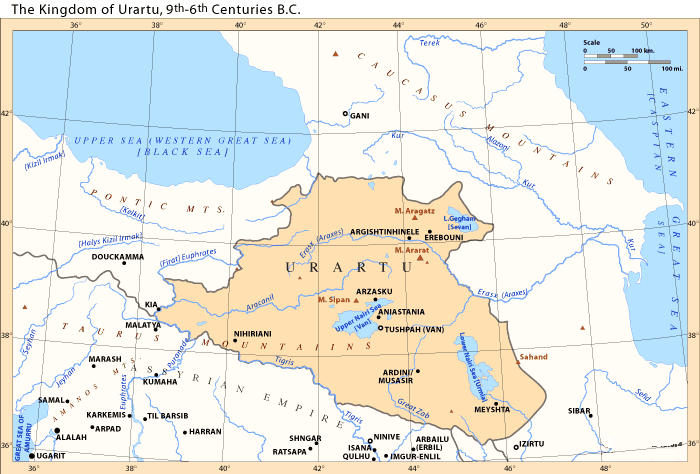
Interestingly enough, in the ancient Kingdom of Urartu (9th-6th centuries BCE) there was a fortress named Ispilibria, Ispilabria, Ispallure6 in Assyrian documents and whose resemblance to the Eteocretan forms is amazing: *Ispili-bría, *Ispila-bría, *Ispall-ure, also with an alternance between stressed -bría and unstressed -ure. It's then possible for isalabre, isaluria to be derived from Urartian if we assume a shift -sp- > *-sf- > -s- happened in Eteocretan7, so the original forms would be *Ispala-bre, *Ispal-uría.

The first member is possibly reflected in the ancient toponym Ispal/Spal (modern Sevilla), whose possible Phoenician origin hasn't been established.

__________________________
1 It's quite possible, alhough not certain, that Eteocretan is a descendant of Minoan, the Pre-Greek language of Crete attested in Hieroglyphic Cretan and Linear A. 
2 There's also a femenine iksalê 'goatskin', with variants isálê, itthélê, ittélê, issélê, isséla, isthlê, itthéla, etc. See R.S.P. Beekes (2010): Etymological Dictionary of Greek, p. 593.
3 See Ray Brown's web page.
4 A Pre-Greek word with cognates in Baltic *keĩm-/*kaîm- 'yard', Germanic *xaim- 'home' and Sino-Tibetan *qim (~ *qwim) 'house'.
5 V. Georgiev (1981): Introduction to the History of the Indo-European Languages, p. 112. 
6 V. Sarkisian (2007): Onomástica vasco-armenia: comparación a través de reconstrucción.
7 But otherwise p > f (φ /ph/ in the Greek alphabet), as in Praisos ~ Fraiso-.

17 July 2013

Basque mahats 'grape' (updated)


Basque mahats 'grape' derives from an earlier *bak-atś, with nasalization of the initial labial and lenition *-k- > -h- (Martinet's Law)2. The second member of the compound is a phytonym suffix *-ats found in other words such as e.g. (g)isats 'broom'. We've got also Galician-Portuguese bago 'grape' (also found in parts of Leonese) from an unattested masculine variant of  Latin bāca 'berry'1. 

The Latin word has no IE etymology, but Boutkan-Kossmann have proposed a link to Berber *bqā 'blackberry, mulberry'3. In my opinion, this would be a Wanderwort also found in Kartvelian *maqˀw-/*muqˀw- 'blackberry' (Georgian maqˀv-al-, Megrel muʔ-, Svan muqˀw, Laz muqˀ-)4 and possibly also Burushaski *maɣar- 'unripe mulberry', Lezghian *niwqˀ:a(j) and Lak qˀul-nuqˀi 'strawberry'. 
_______________________________
1 There's also Hispanic Latin bacca 'wine' (Varron).
2 Unfortunately, academic Vascologists think the only source of -h- can be a nasal *-n- (Mitxelena's Law), so they reconstruct a protoform *banatś (Trask), or even worse, from Romance banasta 'basket' (Manterola).
3 D. Boutkan & M. Kossmann (1999): Some Berber Parallels of European Substratum Words, §3.1, in JIES 27, p. 87-100.
4 Borrowed into Akhvakh muqˀ:ali.

16 July 2013

Spanish chocho (slang) 'vulva' (updated)


Due to its phonetic features, Spanish chocho /tʃótʃo/ (slang) 'vulva'1 (with regional variants chocha, chucha) is considered to be of "expressive origin"2 by Spanish linguists. However, to me it's a loanword from Basque txotxo /tʃótʃo/ (B, G) 'penis' (child word), a variant of tutu (B) 'vulva', (L) 'spout (of a jar)', (Bazt, L), ttuttu /cucu/ (Bazt, L) 'feeding bottle'3. 


This etymology refers to the labia ('lips' in Latin), and thus I'd link the above words to Germanic *tut- 'to project' (Dutch tuit ‘spout, nozzle’, Middle Dutch tute ‘nipple, pap’, Middle Low German tute ‘horn; funnel’), Kartvelian (Georgian) čˀočˀ- 'peak, tip, spout (of a jug)', East Caucasian *t(t)ʃot(t)ʃV 'tip, spout' (Chechen cˀuzam 'spout (of a tea-pot, jug)', Lezghian cˀucˀ 'spout (of a tea-pot), Kryz cˀɨcˀ 'clitoris; ring-stone'), and Tungusic *tʃitʃu- 'penis, spout (of a tea-pot)'.
______________________________
1 The homonymous chocho 'white lupin' is a loanword from Mozarabic śóś < Latin salsu- 'salted'. See F. Corriente (2003): Diccionario de arabismos y voces afines en iberorromance, p. 287. 
2 It must be remarked that expressiveness (a goal which can be achieved by mimicking children language, as in e.g. expressive palatalization, extensively used in Basque for conveying an affective or diminutive meaning) doesn't necessarily implies a phonosymbolic (i.e. onomatopoeic) origin.
3 There's also the homonymous tutu, ttuttu 'tube, pipe; horn, bugle', conflated by Bengtson.

14 June 2013

Basque erramu 'bay laurel'


Basque erramu-igande 'Palm Sunday'1, is a compound from erramu 'bay laurel (Laurus nobilis)' (with a prothetic e-) and igande 'Sunday'. The difficulty of procuring palms in unfavorable climates led to their substitution with branches of native trees (e.g. box, yew, willow, olive), so the Sunday was often designated by their names, as in Basque, or by the general term Branch Sunday, as in several Romance languages (e.g. Spanish Domingo de Ramos), whose forms derive from Latin rāmus 'branch'.


The phonetic similarity between the Basque and the Romance words 
has lead to many specialists to derive the former from the latter, which is highly unlikely due to semantic mismatch2. In my opinion, a better parallel would be the Sicilian phytonym rannu 'Mediterranean sweet scabious (Scabiosa atropurpurea)'3, found in the toponym Grotta 'u Rannu (San Giuseppe Jato) and apparently derived from Arabic rand 'bay laurel'4, with assimilation -nd- > -nn-.

On the other hand, Basque basa-erramu 'spindle (Euonymus europaeus)', a compound from basa- 'wild', designates in turn a plant whose fruits (once dried and crushed) were used as insecticide against acari and lice. 
________________________ 
1 There's also erramu-egun, a compound from egun 'day'. 
2 There's, however, a homonymous (although minoritary) erramu 'oar', which derives from Latin rēmus. 
3  Widespread in the Mediterranean area, this species is also known as Scabiosa cretica. The Latin name alludes to the medical properties of the plant, used for curing scabies, a skin disease caused by a species of mite.
4  R.A. Hall (1974): External History of The Romance Languages, p. 97.

05 June 2013

Cisalpine Gaulish karnitu 'he built' (updated)


The funerary inscription of Todi (Umbria) is a bilingual Gaulish-Latin which contains two Cisalpine Gaulish texts written in the Etruscan alphabet: Ateknati Trutikni karnitu artuaś Koisis Trutiknos, [At]eknati Truti[k]ni [kar]nitu lokan Ko[i]sis [Tr]utiknos 'Koisis son of Drutos, has built the tomb of Ategnatos son of Drutos'1.

The verb karnitu is translated in the Latin text as locauit et statuit '(he) placed and erected', whose object lokan /longan/ 'tomb, cinerary urn' (accusative) corresponds to Celtic *longā 'vessel' (see here). Although some specialists have proposed an etymology from Proto-Celtic *karno- 'heap of stones'2, I think we're dealing with a quite different word. In fact, karnitu can be readily compared to Lepontic karite '(he) made' in the funerary inscription Pelkui pruiam Teu karite, iśos kalite palam 'Devos made (this) tomb for Belgus, he himself raised the tombstone', where we've got the forms bruia 'tomb'3 and pala 'tombstone'.

These verbs, to which I'd add Etruscan car- 'to build, to make', ceriχu- 'to build', would be cognate to Sanskrit karóti, kr̥ɳóti 'to do, to make' < IE *kʷer- 'to make'4, as loanwords from a satem language with the typical delabialization of *kʷ

Interestingly, in some IE branches,  this verb developed a secondary meaning related to magic: Sanskrit kártra-, kr̥tyá: 'enchantment, charm', kárman- 'sacrifice', Lithuanian kerė́ti, keraĩ 'charms, enchantments', kerų žodžiai 'magical formules', Old Church Slavonic čaro-dĕjĭ 'magician'. In Celtic, we've got Old Irish creth 'poetry' (Ogamic Qritti 'poet's (gen.)') and cruth 'shape, form', Middle Welsh pryd < Celtic *kʷritu-, and Welsh prydydd, Old Cornish pridit 'poet' and the Gaulish personal name Prittius < Celtic *kʷritjo-5.
___________________________________________________
1 X. Delamarre (2008): Dictionnaire de la langue gauloise, p. 105-106.
2 R. Matasović (2009): Etymological Dictionary of Proto-Celtic, p. 191.
3 Usually linked to Gaulish brīvā 'bridge'.
4 Attested in Middle Welsh peri 'to cause, to create, to make'.
5 X. Delamarre, op.cit., p. 252.