13 March 2022

Etruscan φersu 'masked character (in games)' (updated)


Latin persōna 'theatre mask' is a loanword from Etruscan *φersu-na > φersu 'masked character (in games)'. This can be analized as a derivative from an unattested form *φers 'husk', an agricultural term with correspondences in Hittite paršdu 'leaf, foliage'1, linked in turn by Alexei Kassian to Kartvelian *purtś 'husk, foliage' (Georgian purcel ’leaf, foliage', Megrel purča 'chaff, husk', Laz purča 'sweet corn ear', purčumale 'a k. of weed'), *prtś-wn- 'to husk, to scale'2.


Presumably related to this etymology is the Greek theonym Perséphonē (Etruscan Φersipnei, Latin Proserpina), attested on several Attic vases from the 5th century BC as Persóphatta, P(h)erséphatta, Pherréphatta. Rudolf Wachter analyzes it as a compound whose second member would be derived from Indo-European *-gʷhn-t-jā < *gʷhen- 'to beat, to kill', and the first one related to Sanskrit parṣá- 'sheaf, bundle', Young Avestan parša- 'ear (of corn)', to which Michael Weiss -in a personal communication to Wachter- also adds Latin porrum and Greek práson 'leek', from a supposed Indo-European lexeme *pr̥s-o-'3. Thus the reconstructed meaning of the theonym would be 'sheaf-beater', i.e. 'threshing maiden'4. 


However, like most Indo-Iranian lexicon related to agriculture, *parš appears to be a substrate loanword from the language spoken by BMAC people5. On the other hand, for Slavic *proso- 'millet', Georg Holzer posited a loanword from a substrate language he called Temematic (Temematisch in German) after its proposed sound correspondences with PIE and where *r̥ ro6. Although Holzer's theory has been discredited as a whole7 it could still explain the etymology of the Slavic word from I*bhar(e)s 'a k. of cereal (milletbarleyspelt)' (Latin far, farris), a remnant of the languages spoken by the Neolithic farmers who colonized Europe from the Near East.

________________________________________________________
Wrongly translated by some authors as 'sprout, sprig'. See A. Kloekhorst (2008): Etymological Dictionary of Hittite, pp. 645-646. 
A. Kassian (2009): Anatolian lexical isolates and their external Nostratic cognates, in Orientalia et Classica, §48.
M. De Vaan (2008): Etymological Dictionary of Latin and the Other Italic Languages, pp. 481-482.
R. Wachter (2006): Persephone, the Threshing Maiden, in Die Sprache, vol. 47, no. 2 (2007-2008), pp.163-181.
5 M. Witzel (2003): Linguistic Evidence for Cultural Exchange in Prehistoric Western Central Asia, in Sino-Platonic Papers 129, p. 33.
G. Holzer (1989): Entlehnungen aus einer bisher unbekannten indogermanischen Sprach in Urslavischen und Urbaltischen, §2. See also F. Kortland (2003): An Indo-European substratum in Slavic?, in Languages in Prehistoric Europe, pp. 183-184.
R. Matasović (2013): Substratum words in Balto-Slavic, in Filologija 60, pp. 75-102.

14 November 2017

Gaulish buððutton 'spindle; penis' (updated)


Gaulish buððutton 'spindle; penis'1 is attested on the spindle whorl Gallo-Latin inscription Moni gnatha gabi buððutton imon 'Come, girl, take my penis'2. The word must have designated the instrument itself and then applied to the male organ in a metaphoric way. Basque buztan 'tail; penis' is presumably a Celtic loanword, probably from Gaulish itself.


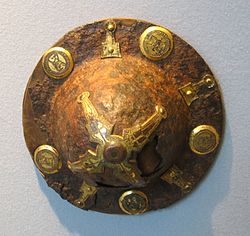
From this and other Insular Celtic words (Old Irish bot 'penis, tail', Middle Welsh both 'umbo, shield boss'), Matasović reconstructs a Celtic protoform *buzdo- 'tail'3, supposedly derived from IE *gwozdo- (Germanic *kwast(j)ō 'bunch of branches', Albanian gjeth 'leaf, foliage', Slavic *xvost 'tail'4), assuming the original meaning was 'to sprout'.

On the other hand, English button is a loanword from Old French boton (modern bouton) 'bud; button; pimple, spot', itself from Late Latin *buttōne-, usualy regarded as a Germanic borrowing, but IMHO actually from Gaulish, which would be also the source of Germanic *buddōn 'bud'.
________________________________________________________________ 
1 X. Delamarre (2008): Dictionnaire de la langue gauloise, p. 92-93. 
2 
W. Meid (1994): Gaulish Inscriptionstranslates the Gaulish word as 'kiss', cfr. bussu- 'lip'. 
3 R. Matasović (2009): Etymological dictionary of Proto-Celtic, p. 85-86.
4 C
onflated by Vassmer to *gvozdis 'nail'.

10 October 2016

Latin costa 'rib; side, flank' (updated)


Latin costa 'rib; side, flank' has been traditionally linked by Indo-Europeanists to Old Church Slavonic kostĭ 'bone'1although more recently De Vaan considers this etymology to be dubious, among other reasons because of semantic mismatch2

In fact, the Slavic word is undoubtedly related to IE *h2osth1- 'bone', although its initial velar stop can't be accounted for in the mainstream model3. The amateur linguist Glen Gordon proposes an early borrowing from a femenine variant of Semitic *kˀa(w)ʃ- 'bow'4 (cfr. Phoenician qšt5)with a semantic drift 'bow' > 'rib' > 'bone'.

In most Romance languages except Romanian, the anatomical meaning of costa was transferred to diminutive forms (e.g. Spanish costilla, French côtelette), while the main word specialized into geographical meanings: '(hill) slope' (e.g. Spanish cuesta) and 'shore' (Catalan and Italian costa), which spread as WanderwortSpanish costa, English coast, Dutch and Swedish kust, German Küste, Danish kyst, etc. There are in addition Middle High German Gestade 'bank' and Old Irish ces 'flank, rump steak', césán 'flanks', which can't be readly derived from costa although they're semantically and phonetically close. 

This makes me wonder if all these words could be Semitic borrowings akin to or from Phoenician qsˁt 'edge, limit' (f.)6 < Semitic *kˀītʃˀ 'end, to finish' < Afrasian *kˀajatʃˀ- (HSED 1562), with Latin and German having got the femenine variant and Goidelic the masculine one.
____________________________________________ 
1 A. Ernout & A. Meillet (1959): Dictionnaire étymologique de la langue latine, p. 146.
2 M. De Vaan (2008): Etymological Dictionary of Latin and the other Italic Languages, p.140. 
3 Gamkrelidze-Ivanov regard these as different reflexes of a former *qʰ. See Gamkrelidze & V.V. Ivanov (1995): Indo-European and the Indo-Europeans, pp. 111-113.
Mª J. Estanyol (2008): Diccionari abreujat fenici-català, p 113.
6 Mª J. Estanyol, op. cit., p 112.

07 October 2016

Latin voltur 'vulture' (updated)


Latin voltur, vultur 'vulture' is linked by scholars such as Mallory-Adams to Greek blosyrós 'terrible, fearsome' and blosyrōpis 'grim-looking' (seemingly from Aeolic in account of *w- > b-), thus reconstructing an IE protoform *gʷl̥tur-1.

However, the Latin word is most likely a loanword from Etruscan velθur 'hawk, falcon', attested in the gentilic Velθur-na, which is likely associated to the city of Capua (cfr. capys 'hawk, falcon'). On the other hand, if the ancient toponyms Vulturnum (Castel Volturno) and Vulturnus (Volturno)2 are actually related to vultur, then we could add too Etruscan velθ 'underground, netherworld', velθu-na 'human', velθ-ra 'infernal tunnel' (Moretti) to this etymology, pointing to a Tyrrhenian protoform *wVrd- 'underground'.

This would be also the origin of Greek Ōrth(r)os, the name of an infernal dog, although from a different substrate language.
_______________________________________________________________
1 J.P. Mallory & D.Q. Adams (2006): The Oxford Introduction to PIE and the PIE World, p.145.
2 Hence (ventus) Vulturnus 'SE wind' > Spanish bochorno 'foehn, sirocco'.

Celtic *marko- 'horse' (updated)

According to Gamkrelidze-Ivanov1, Celtic *marko- 'horse' (Old Irish marc, Middle Welsh march, Gaulish márkan [acc.])2 and Germanic *márxa-/*margá- 'horse, mare' (Old Icelandic marr 'horse', merr 'mare', Old High German marah- 'horse', meriha 'mare') is an Asian Wanderwort related to horseback riding in the Eurasian steppes before the first millenium BC.

The closest forms would be North Caucasian *far-nē 'horse, mare', Sinitic *mrāʔ , Tibeto-Burman *mrāŋ 'horse', with Schwebeablaut. These words3 look as different formations from a lexeme found in Altaic *mórV 'horse' (Mongolian *mori, Tungusic *murin, Korean *màr). One of these derivations, with a nasal suffix (*mori-n), found in Mongol and Tungusic, would be the origin of the Tibeto-Burman and North Caucasian word. The other would be a diminutive *mor-qa reflected in the Sinitic and Celto-Germanic words.
 
However, Sanskrit mṛga 'deer, antelope' would point to a possible origin of this Wanderwort in the domestication of wild horses by the Botai culture of northern Kazakhstan (3,500-3,000 BCE). 
________________________________________________________________________
1 T. Gamkrelidze & V. Ivanov (1995): Indo-European and the Indo-Europeans, p. 472-473.
2 R. Matasović (2009): Etymological Dictionary of Proto-Celtic, p. 257.
3 For which Sergei Starostin reconstructs a Sino-Tibetan protoform *mrāH / *mrāŋ.